
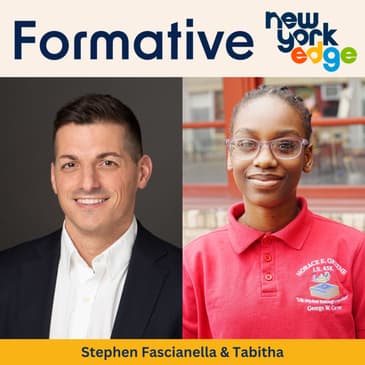

In this episode, Tabitha gets a crash course on what it looks like to successfully reinvent yourself! Stephen Fascianella went from being an accountant to fostering community and engagement as the New York site engagement lead at Pfizer. Tabitha and Stephen also talk about what we get when we give and why it’s important to remain open to change.
Downloadable transcript here
Rachael: Welcome back to Formative, the show where today's leaders are interviewed by the leaders of tomorrow. Today we have Stephen Fascianella with us. Stephen is the New York Site Engagement Lead at Pfizer. We talk to Stephen about why fostering community is so important and the role he plays in doing that within Pfizer and outside of his role at work. We're so excited to get to know Stephen today.
Rachael: Hello and welcome. I'm Rachael Gazdick, CEO of New York Edge. My co-host today is Tabitha from I.S. 45K. Tabitha, tell us about yourself.
Tabitha: Yes, um, hi, my name is Tabitha [inaudible]and I'm in the eighth grade. I have two brothers. I love to dance and draw, and in the future I would like to have my own dance business.
Rachael: Oh, that's so cool.
Tabitha: Mm-hmm.
Rachael: I love that. Um, who are we speaking with today?
Tabitha: We're talking with Stephen Fascianella, and I'm so excited to be speaking with him.
Rachael: Great. Well, let's bring him on. Stephen, thank you so much for joining us.
Stephen: Thank you for having me. Glad to be here speaking with you.
Rachael: Tabitha, what's your first question for Stephen?
Tabitha: So I heard that you work at Pfizer, a pharmaceutical company, but I would like to know what initially drew you to this career path that you have today?
Stephen: It's a really good question, and this is not something I ever thought I would be doing if I'm being honest with you. In college, I studied to be an accountant, left school after four years and worked at PricewaterhouseCoopers, which is a worldwide, um, accounting firm. I worked there for a number of years and actually loved it there. I thought I would work there forever and ever and…well, not ever, until I retired 'cause I am looking forward to that. I, I decided to leave that firm though. I loved my job, but just realized it wasn't necessarily fulfilling me in the way I wanted. And so I started to explore and to interview at other companies.
I wound up here at Pfizer. It was a good pathway for me to use my accounting skills to come here and, and work in an audit capacity internally at the company. And so 17 years later, I'm still here. I've probably had three or four jobs. I never thought I'd be doing what I'm doing. But along that career journey, I was presented with an opportunity. I was doing well, and my boss at the time asked me if I wanted to do something different. She said, Hey, we're getting ready to move to our new office. Um, we're in this space now, maybe going on two years, two and a half years. And she said, when we get there, we need someone to be our site engagement lead. We need someone to really think about how we bring colleagues together. We're at, um, a junction point where we were working remotely for a number of years and now we're coming together in person in a new space, and we wanna put some focus on colleague engagement and community engagement. And so, I paused and took a really deep breath because I didn't feel like I necessarily had the skillsets to do all of that, but I knew it was something that always excited me and I was passionate about all through school, from probably when I was your age, I was always working and giving back to the community and whether it was working in my church or at other organizations, and so to now have the opportunity to do that many years into my career, it really excited me.
Tabitha: My question, what obstacles did you face during this time and what motivated you to keep going through the obstacles?
Stephen: There've been several obstacles, if I'm being honest.
Um, if I try to think about my career journey, there were definitely points where I felt like I was hitting a wall, that, um, I was doing my work and I was doing it well, but was not necessarily a hundred percent fulfilled and there didn't always seem like there was a clear path to do something different because I felt that I was pigeonholed because I went to school and I had a degree in auditing and finance, and I felt like, oh, now this is what I'm stuck doing unless I go back to school. Uh, but I learned, uh, especially when I came over to Pfizer that a company is a big place and there are a lot of different opportunities. There are a lot of different kinds of people and different kinds of job functions here at the company. So just as an example, I worked in finance, but you mentioned before we are a pharmaceutical company that makes medicines, right? We have scientists, we have people who work in our manufacturing plants. We have lawyers who work here. We have people who work in marketing and advertising. We have, um, people who work in a compliance function. So there are lots of different career options when you're here. But I still felt the challenge of, okay, that's great, but I don't have experience in those spaces, so how am I gonna get hired to do that job in the communications function when I've never been a communicator?
So that was a challenge that I faced. And I spoke with my manager, I spoke with some of my mentors and realized that I needed to find a way to get that experience without getting a new job. And it's like, okay, how am I gonna do that? And so I would volunteer to help with things, right? I had a little extra time in my day because maybe this particular month or these next several months were gonna be light in my schedule. And so I'd volunteer to help out on another project. I would do some of that work in my downtime and while still staying in my current job function, I was getting other experience to build my resume, to build my toolbox, as one of my mentors used to say, right? Take that opportunity to work on that special project because you can add another tool to your toolbox, and you never know when you're gonna need that tool. And so that was how I tried to overcome the challenge, and it took me quite a few years. I was in my first department at Pfizer probably for seven years because…
Tabitha: That's a long time.
Stephen: I didn't…I liked what I was doing. I knew I wanted to do something different, but the right opportunity had really not come up. And I did apply for a few other jobs internally at the company but didn't receive them because they felt like I didn't have the right skills and the right tools, and so I continued to build up those skills and tools and about seven years later I, uh, finally had enough, I think, to prove that I was capable of doing something more, capable of working outside of the finance department and supporting the company in a different way.
So I saw that obstacle and took a little time and some extra work, but I eventually was able to overcome it. And I moved into another job function that's not actually the job I had now, but that is a job I was doing for several years and really liked before I wound up in, in my current role.
Tabitha: Okay. What is your greatest accomplishment and how did you achieve it?
Stephen: One of the more unique projects I've ever worked on and something that really makes me smile and I'm very proud of is the creation of something called Pfizer School of Science. We launched this program about a year and a half ago. And since then we have welcomed nearly 14,000 students into our building to learn about Pfizer and career discovery. I don't know if you've ever been here, maybe, or maybe not because we've had a number of students from New York City Public Schools, but also from New York Edge. And so, um, that is a really joyful and happy part of my job. And whenever I'm having a bad day, I usually come up into this space and just look around and, and see the students learning and it really makes me smile. And it really is one of the best and most rewarding projects that I've ever worked on at Pfizer, because not only are we getting to inspire students, hopefully about science, but really just working with them at a young age to think about careers and to think about why it's important to go to school and to study, and seeing the children and the students just get so excited about being here and asking us questions about how we got to where we are and… It just amazes me to hear the types of questions that the students ask at such a young age because I don't remember ever thinking about those things when I was in middle school, but it inspires me on a daily basis.
Tabitha: Um, do you feel like this is your best career option?
Stephen: I'm very happy with what I do now. This is not the end for me. I definitely want to do more and I want to do something different. Right, I started my career in finance. I worked in a project management function for a while, which we didn't get into. I worked in an operational role for a while, and now I'm in this, uh, engagement space, which I really like. I would love to take that and build on that and do something more. There are definitely other groups at Pfizer where we do what I do, but we do it on a more global scale, right? Instead of just working in New York, could I be part of one of our um, uh, philanthropy groups that does this kind of work all around the world that tries to help underserved communities and people and patients beyond New York, right? I'd love to, to take what I'm doing now, and again, I built up my toolbox. I now have these different experiences about working externally and working with communities and working with students. How can I take all of that and take my little toolbox and hopefully apply to another role that's a little more grander and can have an impact on a wider scale.
Rachael: So I wanna go back and talk about what you were like in middle school. What were you thinking about at that age?
Stephen: It’s a good question, and I think about this a lot now that I work with middle school students on a regular basis.
I liked school. I was a good student and I enjoyed being at school. I went to the same school from kindergarten to eighth grade, and so I had a close group of friends that I grew up with and went to school with for all of those years, and I was very involved in my school With all of that said, I don't know that I would've ever been co-hosting a podcast when I was your age. I feel like maybe life was just a little simpler then, but I definitely…There were things I was doing in middle school, all through middle school, I remember I volunteered at an old age home and I used to go and, and visit with people and, and try to give back to the community. I used to go around and shovel people's snow free of charge just because they needed help or I volunteered at my church to do different things.
Uh, and I mention all of that because those are the things that I do now in my job. I always loved giving back to the community. And now here in my job, I'm responsible for community engagement at our New York City office, and I probably helped more than 2,000 people volunteer thousands of hours at different charities around the city to give back to the community. I am right now leading a holiday drive where we adopted, quote unquote adopted, 40 families, and colleagues around the office are helping to buy gifts for these families who maybe can't afford to buy presents for their children. And it makes me think back to, these are things that I loved and cherished as a little kid when I was 13, and now I'm able to help give back in a bigger way 30-some-odd years later.
And so it, you asked me earlier, right, how did I know this is what I wanted to do? I didn't. When I was your age, I think I wanted to be an ice cream man. Um, um, that's what I used to want to do because I always loved how when the ice cream truck came around, everyone was so happy and, and wanted to go see this man and, and buy ice cream and it just brightened their day. And years later, I'm not an ice cream man but I do feel like part of my job is to help make people smile, and it's kind of a full circle moment for me. It's not what I set out to do, but part of what I do now is something that I always love to do, even when I was 10, 11, 12 years old.
Tabitha: Mmmm.
I don't know if that answers your question and now you have me crying over here, hahahaha.
Rachael: Has growing up been for you all it's cracked up to be? Like, what's your favorite and least favorite thing about being an adult?
Stephen: Oh my gosh. Well, my favorite thing about being an adult right now is that I am a dad to a one and a half year old daughter.
Tabitha: Aww.
Stephen: Um, that is definitely the most important thing in my life right now. Um, my husband and I had our daughter a year and a half ago through surrogacy, and she's the joy of our lives. And the hardest thing is, I don't know, I felt like it was easier to be a kid. I had less responsibilities. I had my parents to watch out over me and, and help me with all my decisions. But when you get out in the real world and are an adult and have a lot of responsibilities and need to get up and go to work every day, it's different than school. I tell my nieces and nephews all the time, enjoy this time while you can. I know it seems stressful at times, and school is a lot of work, but the stresses and the problems get bigger as you get older. I know they probably seem big now for you, and I know it can be challenging, but they do get bigger, I promise you that. And so enjoy this time while you can. Explore, learn, that way you can try to make some good career decisions and, and hopefully do something that you love at the end of the day.
Rachael: Yes. So our last question, if you could go back in time and speak to yourself at 13…
Stephen: Oh my God, you're gonna make me cry again.
Rachael: Knowing what you know now, what would you tell yourself?
Stephen: It's okay to be different sometimes. It's okay to be scared. There were definitely things I didn't do when I was younger just because, either my friends weren't doing them, or I wasn't sure I could do it or do it well. Uh, I would say to myself and and say to you is, just give it a try. It's okay to fail. Sometimes your biggest successes come from failing because you'll either learn to do it better or maybe you'll learn, just learn that wasn't the right path for you and you should try something new. And so definitely try, don't give up, challenge yourself and believe in yourself. And rely on the people around you who love you, because sometimes we forget that and maybe we think they're a little annoying at times. Whether that's a parent, a friend, an aunt, an uncle, a cousin, find who those people are and rely on them to help you navigate the difficult times and the challenging times.
Rachael: That's great advice.
Tabitha: Mm-hmm.
Rachael: Thank you so much. It was just so nice talking to you.
Stephen: Of course. It was great to meet you both. Thank you, Tabitha.
Rachael: You too.
Stephen: Bye.
Tabitha: Bye.
Stephen: Thank you.
CREDITS
Thanks for listening to Formative, a production of New York Edge. I’m your host, Rachael Gazdick. Our production partner for this series is CitizenRacecar. This episode was produced by Hajar Eldaas, post-production by Alex Brouwer, original music by Garrett Tiedemann. Thanks to the whole team at New York Edge for making this series possible. Never miss an episode by subscribing to the series at newyorkedge.org/formative or wherever you get your podcasts.