
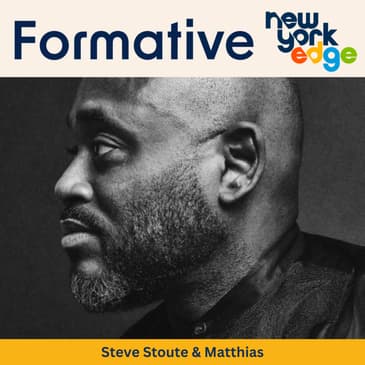
Steve Stoute joins middle schooler Matthias to share how he got his start in the music industry, from working at the lowest level behind the scenes to managing major artists like Mary J. Blige and Nas. He reflects on the responsibility that comes with leadership, what he looks for in young creatives, and why long-term commitment matters more than instant success.
Downloadable transcript here
Rachael: Welcome to a new episode of Formative, the podcast where today's leaders are interviewed by the leaders of tomorrow. Today our guest is Steve Stoute, a music industry executive, entrepreneur, and founder of UnitedMasters. Today, Steve talks about starting from the ground up in the ever-changing music industry. He also shares advice on commitment, preparation, and why the way you handle the small things shapes how you show up for the big ones.
Hello and welcome. My name is Rachael Gazdick, and I'm your host and CEO of New York Edge. On every episode of Formative, a student from our afterschool program joins me as co-host. Today we've got Mathias from IS 125Q. Mathias, can you tell our audience a little bit about yourself?
Mathias: My name is Mathias. I'm from IS 125. As she said earlier, I'm an honor student, my favorite subject is math, and my favorite color is green.
Rachael: Amazing. I think we're ready to go talk to Steve Stoute. Mr. Stoute, welcome to our show. We're so happy to have you.
Steve: Thank you for having me. This is awesome. I'm proud of what you guys are doing. I'm proud of the students and their efforts, and anything that I can say to inspire or lend insight to their beautiful journey, I'm more than happy to do that.
Rachael: All right, Mathias, what's your first question?
Mathias: My first question is, how was it working with artists like Mary J. Blige and Nas?
Steve: Well, just in general, I would say that becoming a manager was something that happened early in my career. You realize that you are managing a lot of responsibility, and you want to make sure, as a responsible person, that you're doing everything possible to help the person you're managing grow in their career. You're giving them really good advice, and as you're learning, you want to make sure that you've gathered enough information to be helpful at all times.
Mary J. Blige, who's a legend, and Nas, who is a legend,both of them bet on me early in my career and believed that I could be helpful. It's something that shaped me into the person I am today because them trusting me with that level of responsibility forced me to become better. I was 24, 25, early in my career, and that has stuck with me ever since.
Rachael: Before we get a little deeper into your career, I would really love to hear about what got you into the music industry in the beginning.
Steve: I found myself in the industry essentially because rap music was very early at that time, and it was a niche group of people who were in control of it. If you were on the scene,at the parties, around the music videos, around the artists,you could find yourself in proximity to an opportunity.
So I found myself around it enough that someone gave me a chance, and I started at the bottom. I started as a roadie, which is the person who checks you into hotels, carries the bags, that kind of stuff. So it was really starting from the bottom and then getting opportunities by being really good at the tasks put in front of me. A lot of them in the beginning were entry-level tasks.
Mathias: What did you see in the music industry that made you start UnitedMasters?
Steve: What was clear to me was that there was a new generation of creatives emerging, and they needed tools to be able to publish themselves versus trying to find the approval of a record company. Today, you can turn a camera on yourself and put something on YouTube or TikTok, and somebody can discover you.
Many years ago, that wasn’t possible. You needed a record deal or a TV deal,someone had to validate you first. That validation layer has disappeared. Now you can release music or content and find opportunities through people who discover you and want to follow your journey.
Mathias: What was the hardest part of building UnitedMasters?
Steve: Managing people and keeping up with the needs of the creative industry. When you're working with independent creatives and building software, you have to make sure it's always evolving and meeting their needs. You're managing many different disciplines,graphic design, engineering, marketing, the creative process. It's a lot.
And when you expand globally, you’re dealing with different countries and languages. The constant movement of it all is challenging.
Mathias: As a CEO, do you get a lot of requests from artists?
Steve: Oh yeah, definitely. Throughout my career, I’ve had a lot of artists asking for advice or looking to collaborate. It’s fulfilling to know people believe in your vision and want to work with you. Over time, you learn to be a leader.
Mathias: What are you looking for in a young artist?
Steve: Commitment. The idea that you can make one song or video and instantly succeed is unrealistic. If it doesn’t take off and you get discouraged, that’s a problem.
I’m looking for people who are committed to the craft,who keep creating, keep failing, and keep learning. That’s what matters.
Rachael: What makes a good leader?
Steve: It’s the same in any industry. People have to believe in you and want to follow you. That requires leading by example and being willing to take initiative.
Mathias: What was a hard time in your career?
Steve: Anytime you hit a challenge, you have a choice,quit or keep going. I’ve never seen anyone win who quit. Like Kobe Bryant said, you can’t make shots you don’t take.
How you do anything is how you do everything. If you procrastinate or don’t try hard, that carries over into every part of your life.
Mathias: What did you learn in middle school that helps you today?
Steve: Math. It’s the music business, and people forget the “business” part. Also, storytelling,understanding what makes a story powerful.
Rachael: Mathias, that’s your favorite subject,so you never know where it can take you.
Steve, did you make any mistakes in school that taught you something important?
Steve: Plenty. One big lesson came when I tried out for the football team. It was harder than I expected, and I quit after a few days. But it didn’t sit right with me.
The next year, I prepared. I trained, got in shape, and when tryouts came around, it was easy. I made the team and had success.
That taught me two things: don’t quit, and preparation pays off.
Mathias: If you could go back to your seventh-grade self, what would you say?
Steve: Be more patient. Patience makes you a better listener and helps you make better decisions. Rushing without all the information usually leads to mistakes.
Rachael: That’s great advice. We’ve really enjoyed learning about your life and career. Thank you so much for being on the show today.
Steve: Thank you.
CREDITS
Thanks for listening to Formative, a production of New York Edge. I’m your host, Rachael Gazdick. Our production partner for this series is CitizenRacecar. This episode was produced by Hajar Eldaas, post-production by Alex Brouwer, original music by Garrett Tiedemann. Thanks to the whole team at New York Edge for making this series possible. Never miss an episode by subscribing to the series at newyorkedge.org/formative or wherever you get your podcasts.