
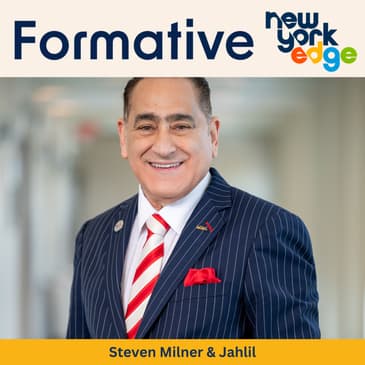

Steven Milner, founder of US Mortgage Corporation, joins middle schooler Jahlil to share how his career took unexpected turns, from engineering to teaching to entrepreneurship, and why taking risks played a key role in his journey.Steven also tells us about a tough experience that tested him and what he looks for in a strong team.
Jahlil learns from Steven how planning ahead, staying motivated, and doing the right thing can shape your future.
Downloadable transcript here
Rachael: Welcome back to Formative, the podcast where today's leaders are interviewed by the leaders of tomorrow. Today we're joined by Steven Milner, founder and CEO of US Mortgage Corporation, which he launched in 1994 after beginning his career as a teacher and then a loan officer on Long Island. Today, Steven talks about his unconventional path into entrepreneurship, the risks and challenges of building a company, and what it takes to lead and grow a team. He also shares advice on planning for the future and why doing the right thing matters more than simply being right.
Rachael: Hello and welcome. My name is Rachael Gazdick, and I'm your host and CEO of New York Edge. On every episode of Formative, a student from our afterschool program joins me as co-host, and today that's Jahlil from I.S. 381K. Jahlil, can you tell our audience a little bit about yourself?
Jahlil: Hi, I'm Jahlil. I'm 13, and as a hobby I like to play soccer and I play chess from time to time.
Rachael: Ooh, those are great hobbies. Okay, I think we're ready to go talk to Steven Milner.
Jahlil: Okay, Mr. Milner, my first question is what inspired you to start your own mortgage company?
Steven: Okay, this will take about a week. I always say that, you know, we all have an evolution as it relates to our careers, and no one wakes up one day, and I know mostly everybody in the mortgage banking business, no one wakes up one day and says that they wanna pursue mortgage banking for the rest of their lives. And that's probably true with most professions. I don't think we really know what we wanna do when we're 18 years old or even when we graduate college.
And my story is no different. My story began when I got a degree in civil engineering. I started working in the engineering department of the Department of Civil Service, the top Department of Transportation. I did not like it. I thought that maybe I should do something else, so I decided to go into education. Then I got a job teaching elementary school in the same school with the same teachers that were my teachers as a kid.
Then I got a master's degree in mathematics so that I could teach math from grade seven through twelve. I proposed and got married, and then my son Scott, who's currently the president of my company, was born on June 5th, 1978. So we went from making $30,000 a year to $15,000 because we felt that one of us should stay home, so she stayed home. But we'd lost 50% of our income.
So I went to refinance my house and my life changed. I sat down with the loan officer. She took my application so that I could take some equity out of my home to pay off my credit card debt. And I thought it was an interesting career to pursue. So I sat down with the sales manager. He started talking to me about what mortgage banking is all about. I became a student of the business. I read some very extensive books about mortgage banking and loan origination, and I started in a salesperson capacity.
I was doing that part-time, and by 1986, I had gotten my PhD in mathematics and school supervision, and I was also closing 25 to 30 loans every single month, making about $30,000 every single month as a loan officer, as a salesperson. And I decided to leave teaching after 18 years. I gave up my pension, my retirement, my salary, my benefits to become an entrepreneur.
Jahlil: That was an amazing answer. My next question is, if you had any challenges, what was the biggest one when you first started your company?
Steven: When I first started my company, well, the biggest challenge firstly is that as a bank, you have to have a certain amount of money in the bank. You have to have what's called liquidity because you're making loans to people, and that's a challenge for a mortgage company.
And the other challenge, which is just as important, is maintaining a sales force that creates the sales activity that generates the profit for the company.
Jahlil: Okay. Could you tell me a specific story where things went very wrong?
Steven: So in 2003 or 2004, I did a loan for a couple. I lent them the money. I made the mortgage loan to them. They bought a nice house on Long Island overlooking the water.
And what happened was when you make a loan, the borrower makes representations that are supposed to be true and accurate about their income, about their assets, about their credit. And this transaction was such where the borrower was buying his son's home, and he was gonna live in the home, and he did that to help out his son who was having economic problems.
And the father then, because we gave him the mortgage, was responsible for making the payments on the loan, right? And since 2004, the last 21 years, he has not made one payment to me in 21 years, and his son is still living in the house.
Jahlil: So are you ever gonna, like, repossess the home since he's not paying for it?
Steven: Yes, I've spent about a million dollars trying to repossess the home, but there are attorneys out there that specialize in delaying what's called the foreclosure proceedings. At this point, I just basically have forgotten about it, as the son still lives in the property, but they're not the borrower. The father, who was the borrower, passed away.
So if you're asking me one of the most challenging, that's been an emotional challenge and a financial challenge, but that's the risk when you become a banker.
Jahlil: So I have another question that kind of relates to this story. How did you stay motivated during this time?
Steven: I stayed motivated because I had other responsibilities to my employees and to continue to grow the company. I've never let one loan, and I've had other loans where I've had to foreclose on the property because the borrowers didn't make their payments. Many companies went through that during the financial crisis, which lasted from 2000 until 2012, and that's what caused them to go out of business.
And I've just always been very motivated to continue to grow the company and to expand throughout the country, and that's what I continue to do.
Jahlil: What do you believe your strength is as a CEO?
Steven: Well, in my case, my highest and best use is to help loan officers, salespeople, become better at what they do. I'm a very good trainer and mentor when it comes to training. I'm very involved with my salespeople as it relates to what their goals are financially and professionally. I really embrace mentoring and teaching and training them.
Some CEOs in the mortgage business don't like doing that. I happen to enjoy doing that a great deal. We're a wonderful company, and one of my core values, one of my sayings about the company, is that we're big enough to matter, yet small enough to care.
Most of my employees have been with me for 30 years. I just love my employees and I love knowing about their personal life, their health, their children, their significant others, their families, and so on. And I'm very involved in their lives, and that's important as a CEO to do that.
Some people live to work, some people work to live. Working to live is budgetary in nature, meaning that you have to feed your family. Living to work is when you have a passion. You develop a passion for what you do every day, and that's what I do. And most of my employees have that passion when they come to work every day.
Jahlil: So my next question is: how do you choose people to work in your company?
Steven: So when I sit with someone who wants to join my company, I have a very deliberate exercise that I go through. I conduct an interview where I ask them to share with me where they have been in their business and personal life, where they are now in their business and personal life, and where they are going.
And I tell them my purpose in doing that is so that I can walk away from that meeting thinking of a way that I can help them get to where they wish to go from a business standpoint.
So before they tell me their story, I tell them my story. I talk about where I have been, where I am now, and where I am going. That creates a level of comfort with the person I'm speaking to, and as a result, they feel comfortable, and then I walk away thinking of a way where we can be aligned, where I can help them with their objectives about getting to where they want to go.
Most people are more interested in gaining first before they give. My philosophy is that you have to find a way to give first before you gain. So to give first, you wanna learn their story, and my objective is to find a way to help them increase their business or help them reach the goal that they're looking to pursue.
How's that for an answer?
Jahlil: Yeah, that's a really good answer. You explained your criteria, what you want the person to do. Which brings me to my next question. What do you believe makes someone a good teammate in your company?
Steven: I think what makes a good teammate is someone who consistently demonstrates the ability to do the job and the willingness to do the job.
I have met many people who have a willingness to do the job, but they don't necessarily have the ability. Then I've met those that have the ability, but they don't really wanna do the job. They don't have the willingness.
So I'm constantly assessing if a person has the ability to do the job and the willingness to do the job. They have to have both. They have to have a passion for what they do every day when they come to work, and that's what makes good teammates.
If they don't have that passion, they're not gonna be happy in what they do, and I think that applies to anything you do in life.
Jahlil: This brings me to my final question. What advice would you give someone like me, a middle schooler, who might dream of owning and founding a company like you?
Steven: Well, so there's a great song by a gentleman called Bob Seger. He has a song called Against the Wind, and in the first verse of that song, he talks about the relationship he has with Janie and how Janie is holding him tight and how she loves him and how she's never going to leave him.
In the last line of the first verse, he says the following. You ready? He says, "I wish I did not know now what I did not know then. I wish I did not know now what I did not know then."
Meaning that as much as Janie loved him, she broke off the relationship, and he had not known that. He wishes he would've known it earlier before she broke up with him.
And I have converted that line to the following as it relates to your question, which is this: If you could see the future, then what would you want to know now?
Think about that. So when it comes to planning, as you're asking me, you have to have a plan and you have to try to envision what that plan is going to look like. If you fail to plan, then you're planning to fail.
So when you think about that statement, "If you could see the future, then what would you want to know now?" that's how every successful entrepreneur ultimately became successful.
Rachael: Well, you led us perfectly into our final question, which we ask every one of our guests. If you could go back and speak to yourself when you were Jahlil's age, 13 years old, knowing everything that you know now, what would you tell yourself?
Steven: What would I tell myself? Life is not about being right. Life is about doing right.
I think too many people are focused on being right instead of doing right. I think as human beings, we know what the right thing is to do. I don't even think we need to be taught that. We know what the right thing to do is.
It's not about being right and focusing on just being obsessed with being right. It's about doing the right thing.
Rachael: Well, this has just been such a pleasure and thank you so much.
Jahlil: Yes, thank you a lot. I'm very happy to know what you do and how you do it.
Steven: Very good. You did a great job, young man.
Jahlil: Thank you.
CREDITS
Thanks for listening to Formative, a production of New York Edge. I’m your host, Rachael Gazdick. Our production partner for this series is CitizenRacecar. This episode was produced by Hajar Eldaas, post-production by Alex Brouwer, original music by Garrett Tiedemann. Thanks to the whole team at New York Edge for making this series possible. Never miss an episode by subscribing to the series at newyorkedge.org/formative or wherever you get your podcasts.