
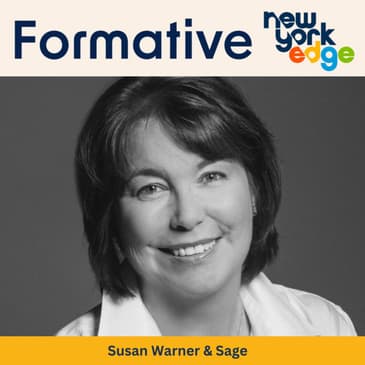

Susan Warner joins us on today’s episode. Susan is Vice President of Community Engagement for Mastercard's Center for Inclusive Growth. Susan also created a STEM program called Girls4Tech. Joining Susan is middle schooler and co-host, Sage, who learns that we should pursue our passions in full force because it’ll be the greatest gift we give ourselves. Susan shares with Sage what she would do differently if she could do it all over again and what the third act of her career may look like.
Downloadable transcript here
Rachael: Welcome to another episode of Formative, the show where today's leaders are interviewed by the leaders of tomorrow.
On the show with us today is Susan Warner. Susan is Vice President of Community Engagement for MasterCard Center for Inclusive Growth. Susan also created a STEM program called Girls4Tech. We talked to Susan today about her love of Shakespeare, the joys of knitting, and the importance of education. We are very excited for you to hear this conversation.
Rachael: Hello and welcome. I'm Racahel Gazdick, CEO of New York Edge and my-co host today is Sage from I.S. 45K. Sage, can you tell me a little bit about yourself?
Sage: Okay so, my name is Sage. I'm in the sixth grade. My hobbies are dance, basketball, and art. I have two sisters, a big family, and I one day either want to go to UConn or Harvard, and I want to be a WNBA player or the president.
Rachael: Oh, that's so cool. So, Sage, who are you interviewing today?
Sage: We're going to be speaking to Susan Warner. She is the founder of a program called Girls4Tech. I'm so excited to speak to her.
Rachael: Well, awesome. Let's welcome her in. Susan, thank you so much for being here.
Susan: Oh, thank you for having me.
Rachael: Okay Sage, the mic is yours.
Sage: My first question is what inspired you to do your career that you, like, have?
Susan: Oh, okay. Well, we're starting with the hard questions first. All right, Sage. Uh, well, what inspired me was two things. One, my mom. She raised five kids on her own. She taught herself to be a bookkeeper. That's how she kept us five hungry bratty kids, um, happy and I just watched her work so hard and she always told me math would be my friend and I was like, Oh, what are you talking about? Um, and I actually did score higher in math and all the tests, but I ended up pursuing community, like English, literature, communications, and I Probably took the safer route because I, I didn't, in my, where I grew up, not a lot of STEM role models. I didn't know what I could do with a math major. And I just had a limited scope, you know. So I chose the easy route because I love to read. I would have five books going at a time. That's when I feel my best. Just going from book to book, chapter to chapter. And, and I really enjoyed that education. I thought it was fantastic.
Um, but I always had this passion for STEM, science, technology, engineering, and math, and so that's how, uh, kind of, you know, I've been thinking about a STEM program for girls because I didn't have the role models, but I wanted your generation to have the role models so that you could be anything you wanted to be.
Sage: I appreciate that. I, I also used to want to do like STEM and stuff. So my mom signed me up for a bunch of classes, but then I, I decided I wanted to do more like a sports career, like basketball and stuff.
Susan: That's okay. You know what? There's a lot of STEM in sports. Think of aerodynamics. Think of physics. All of that connects. There's a lot of science, technology, engineering in sports professions. Think of the turf that you play on. Think of the uniforms you wear. All of that is considered science, technology, engineering, and math. So you can have both.
Sage: That would be very nice. I probably will end up doing that. But another question is, if you could go back and do it all over again, would you study a STEM degree?
Susan: Someone once asked me why I didn't pursue a STEM career. And, um, I didn't have a good answer at the time. I just thought, well, you know, I just pursued English. That's, that's cool. But that got me thinking, you know, why didn't I pursue it?
And I think it's, it was the lack of role models. It was kind of the lack of vision for what I could do with those majors. I think it was lack of confidence in myself. So that question kind of led me to the creation of Girls4Tech. So it was a good question to ask me.
Um, if I could do it all over again, I would attend a girls for tech course. And we have several of them. I would learn how to code. I would, cause I think that's another creative expression is coding. It's another language that I think we should all know. I think that I would probably be a really good program manager connecting the business with the technology, just understanding the tech team and what they need to go to achieve something, but also understand the business needs. Um, I think I would be a good tech writer because I can talk simply and get to the point. Um, try to not be confusing. So, um, yeah, I, I would have a different career. But, you know what, it would still connect with literature, it would still connect with writing, it would still connect with communicating the business value of technology.
Sage: Um, where, what college did you go to and what did you major in?
Susan: Well, the possibility of me going to college was slim. We didn't have a lot of extra money. I saw all my friends applying. No one in my family had gone to school yet. Um, so I was the first, so I was just applying away and it was Hartwick College ended up giving me almost a full ride and I paid a little bit by working, uh, three jobs during the summer, but they were very gracious to me. And so I'm very grateful for what the gift that they gave me. And today I serve as a board of trustee for the school to, to help others like me. It, it was a wonderful opportunity for me and my family. It just changed my life.
Sage: What did you major in?
Susan: Oh, I forgot to tell you. English literature. So Shakespeare was my friend.
Sage: He, he confuses me with those, the words sometimes he uses in his books.
Susan: Yeah, the vowels and the alarm and flourish. Yeah, alarm and flourish. Yeah, I used to, once you read one play, you kind of get used to it, and then the other plays just like you're in that world and you can keep going. But when I go back to look at like Much Ado About Nothing, I'm like, oh, this is going to be a slog. But again, you get so accustomed to it. It just becomes part of you and part of your skin. You just keep, got to keep going at it.
Sage: Yeah. The only one I like really know is Juliet, Romeo and Juliet. That's I think one of his most popular ones. That's the one that I can say like the storyline-ish.
Susan: Yeah, so that's great. The fact that you already know about Shakespeare, that's wonderful. And go to some of the plays that are out there because they're great. He was one of our greatest writers of all time in history.
Sage: Um, do you use your English degree now?
Susan: Oh, yeah. So, you know, my career was mostly in communication. So, I became a writer and I used that skill.
the entire time. I still use it today. I write blogs. I'll write articles. It's a treat to write now because I don't write as much as I used to. And I write, sometimes I write children's stories. I haven't done anything with them yet, but you know, now it's so much fun to just sit back and write.
Sage: That's very nice. I like creating my own stories. Like if you give me a paragraph and tell me, write about this paragraph, that's not as exciting as if I get to like make up my own stories. My teacher says that whenever she gives us like an assignment or he to write imagination, use your imagination for the story. They tell us they're like, you're in the driver's seat, you can do whatever you want with it. And I love that.
Susan: That's fantastic. That's great feedback. That just says you're a creative writer and keep exploring that.
Sage: What is one thing about you that I would never guess?
Susan: Oh, I, okay. I used to be a publicist for a couple of rock bands. I used to work with the wrestlers. When I was in external communications, before I started doing more writing, it was more about getting media coverage for celebrities. So yeah, that might be something that you'd never guess, with now me, this little old lady sewing and knitting.
Sage: You're funny. Um, what do you like to do for fun on your free time?
Susan: Oh, um, well, spending time with my daughters is paramount and, and my husband, um, so family is, is first. I like to sew. I find that destressing for me. Destressing. To de stress? Yeah, I think that's a word. It's calming, put it that way. I tend to want to always be busy, no matter what it is. Sitting still is rough for me. So I'll needle point, I'll cross stitch, I'll knit in the winters because it's not as hot as when you knit in the summer. I'll knit big blankets. So I really enjoy creating something. And when I'm making something for somebody, I'm always thinking about them. So if I'm making a stocking for one of my girls or a blanket for some, someone, uh, I tend to, like, I know in that fabric that their story and my memories of them are woven in there. I find it to be just very relaxing and cathartic.
Sage: That's such a coincidence because my older sister, her name is Kaya, and she literally, she applied for high school. It's HS FIT. It's like, you know, FIT, the college, it's like a high school version of that. And she got in and I was surprised she was going to, she's sewing her prom dress, but like there's eighth grade prom in our school. So she's going to sew it and she's pretty good.
Susan: That's, keep that skill. I learned on a machine and I didn't keep it up and I frankly wish I had. So, um, you know, when I get a little bit more free time, I'm going to pull that machine out again and start cause I quilted for a little while. So, uh, yeah, keep that skill. Tell her, tell Kaya to keep that skill up and teach it to you.
Sage: Yeah, I tried sewing. It gets me frustrated because. Me and art, it's like hand art and stuff with your, not like dance art and stuff, but like hand art. I get really frustrated when, like, I like when things are like perfect, like perfectly straight and all that, and I be getting angry when it doesn't turn out.
Susan: Just, you know what, keep practicing and have fun with it. That's all.
Sage: Yeah.
Rachael: Sage, when Susan was talking about always having to stay busy, I saw you nodding your head. Is that also how you are?
Sage: Yeah, it's not like I have ADHD or anything like that, but I keep on, like, I always need to do something, if you get what I mean.
Susan: I'm with you, Sage. I don't know. I wish I could sit still, but it's very hard for me.
Sage: Yeah.
Susan: So that's why, you know, oh, and my husband loves sports and I like sports, but I don't love it. Um, so when I was dating him, my mother in law said, well, you better take up a hobby cause we like, we watch a lot of sports. So I was like, okay, teach me how to cross stitch. So she did. So, you know, when he's watching sports, he likes the fact that I'm sitting nearby and I'm just sewing away. And again, it's just, it's an outlet for my just internal energy.
Sage: That's really nice. I'm gonna learn how to do that now.
Susan: Yeah, I'll teach you.
Sage: Um, what's one cause that you deeply believe in?
Susan: I deeply believe in the power of education. I think that's really critical. I believe in education and opportunity for all so that everyone's on the same boat and opportunities are equal for all.
Sage: Yeah, that's really nice. I would love that. This world is very, it's not, I'm not going to say bad, but some things could change that would make this world better.
Susan: I agree. I agree. And I think it's going to take talent like you Sage to make changes. So don't give up.
Sage: What's one thing you want to do in life, but you don't know where to start.
Susan: Oh, well, I do have a second, or I guess this would be my third career in mind. When I retire, I want to be an adjunct professor.
Sage: What's that?
Susan: Oh, so this would be like in college, like being a, I think it's like a temporary professor.
Sage: Like a substitute almost?
Susan: Yeah, well not a substitute, but you come in on specific subjects. So I could teach business communications, I could teach corporate social responsibility. I could teach maybe creative writing. So yeah, so that's my next gig is how do I become a professor and hopefully motivate girls like you.
Sage: That's pretty smart that you have it planned out like that.
Susan: Now I got to go do it.
Sage: Um, do you have a favorite quote from somebody?
Susan: Well, there's a one, um, “Be yourself because no one else can be you.” I think that's it. Was that Roosevelt? I might have that wrong, but we, you, we can correct me, but I think that's a good quote because bringing your whole self into whatever you do, I think is so important. When I got to MasterCard, I brought my fun, kind of goofy self to work every single day and it worked, you know, and I've been here 13 years. So, um, I think being yourself is really critical and not be influenced by others. Just stay true to who you are.
Sage: That's, that's very inspirational. That's a nice quote. I like that.
Susan: I might have made it up but we'll check, we'll fact check myself.
Sage: I'll do that when I, when we get off the call. I'm gonna make sure.
Susan: Where did you grow up? I grew up in Southold, Long Island. So, um, if you picture the map of Long Island, there's two forks. I'm on the, I grew up on the North Fork. So it was very, at the time, it was very rural. Um, one stoplight I grew up, I had went to class, I think with 70 students. So it was pretty small, but it was, it was a great place to grow up because you could play, you could run, you could, um, build forts. Like it, there was a lot of. creativity and freedom.
Sage: That seems a lot of fun. Um, but another question is, what were you like in middle school?
Susan: I was very quiet, um, in the beginning. I was one of five and I was a fourth child. So I kept to myself. I read a lot. I played, uh, it was, I think I was playing the clarinet at the time. I was, probably a band nerd but I would, I would do music competitions on the weekend. So, um, I did a little bit of sports. But one day in class, I think it was eighth grade. I told a joke, like I said something funny. And I remember my classmates turning around and saying, Oh, she speaks. And then after that, I was kind of like the class clown. Like it just, but I think if I think about who I am, I can be funny. I love to be funny, but I'm also a very quiet introverted person. So all at the same time.
Sage: That's, that's wow.
Susan: How about you? What would you, how would you describe yourself?
Sage: Oh, I'm very outgoing. I'm pretty loud, and I love talking.
Susan: You go, girl!
Sage: And I like to be in like everything. I have a, I used to have way too many hobbies so I had to set some down because it was beginning to be too much for me to handle. Now I only do three. That's good. That's really good. What are the three? Oh, dance, basketball, step.
Susan: That's right. Okay. That's fun. Those are fun activities.
Sage: Yeah. Um, which grade do you think was like your best grade? Like your favorite grade did you like the most that you were in?
Susan: Well, I love third grade. We made apple jelly from scratch and I thought that was really awesome. And that teacher, Mrs. Woods, she was very, um, pushing me forward, giving me confidence. So I like third grade and I also like my senior year of college because I think I finally put everything together and I was getting really good grades and I was really working hard. So, those are the two.
Sage: Did you have a lot, like a big friend group or more of a just you and your best friend type of?
Susan: I didn't have a big friend group. I never have. Um, always more, um, close, kind of meaningful friendships. So I tend to, if I go out to a party, I'll tend to talk to just a couple of people. I'm not, my husband will go and talk to everybody. I just tend to have more quiet conversations and I like that.
Sage: Um, who was the most influential person in your life and how did that impact you?
Susan: Oh, I'd go back to my mom. So, like I said, she raised five of us on her own and she's just a hero in my eyes, was my best friend. We would talk like twice a day and I wish she was still around because I'd love to tell her even about today's interview because she would just love it. So, she's my hero and someone I just love want to emulate.
Sage: That's very sweet.
Rachael: What about you, Sage? Who is the most influential person in your life?
Susan: Oh, good question.
Sage: Oh well, I can't really choose one because I would say both of my parents because they're like opposites. So my mom is more on the artistic side, like, more calm and chill. Everybody says I act like my, like, exactly like my dad. Like, we have the same facial features, like, the way we just I don't know how to explain it, but like, they say I act more like my dad than my mom. And my dad, he's like my, he's basically my basketball coach for our team. So, he's pretty influential for me, because he pushes me to be the best version of myself, and my mom is more like my comfort person. She really helps me when I'm not doing so good, like when I'm stressed out and stuff like that.
Um, what advice do you have for girls my age?
Susan: When I look at talent that I see now, we're always looking for employees who are curious and have initiative. And I think those two skills are really important. You'll hear about like the growth mindset. All that means is that you're curious, you want to learn, you just want to keep learning more and more things. I think that's so important. I'm a lot older than you are, but I'm still curious. So I'll dig into things and just start reading about it because just because you want, I want to know about that. And I think that's really important.
Um, having initiative. That means getting things done, right? Going the extra mile. That, to me, those are two traits that I'm always looking for and I love to see it in girls like you because I know that everything's going to be okay and the world is going to be okay because you girls got it and you want to, you know, you want to take on the world. You want to solve problems. I think that's fantastic. And I think your generation is going to be, you know, I'm going to be sitting in my rocking chair, watching you take on the world and I'm going to be so happy.
Sage: That's very nice. I do want to do stuff like that. Me and my friend, we had a plan that it might happen. We were saying like, if our other careers, if we turn out not wanting to do that, she said she wanted to be like a scientist or something. And we said, what we wanted to do was we wanted one of us to become the president and the other to be the vice president when we're older. And we're like, we'll make sure that happens.
Susan: That's awesome. That's so awesome. And you know what? You could have multiple careers. You can go in various different directions. And so that's what, never say, you know what, I'm too old to do that. No, you're not like, keep going. Being president I think is a fabulous aspiration. And I'm saying vote for Sage.
Rachael: Our last question for you, Susan, is if you could go back in time and speak to your 13 year old self, what would you say?
Susan: If I could talk to my 13 year old self, I would tell her to believe in herself, that she does belong, that she can contribute and make a difference. I think when I was 13, I didn't see that. So I would love to go back and say, you got this. Even when others are telling you, you don't, you do, you've got it. So that's what I would say to her.
Rachael: That's wonderful advice. It's just been such a pleasure getting to know you today.
Susan: Oh, my gosh, this was so much fun. Sage, you rock. You are just incredible.
Rachael: Yes. Sage for President.
Susan: Your composure, your your questions. You were, you're amazing.
Sage: Thank you so much.
CREDITS
Thanks for listening to Formative, a production of New York Edge. I’m your host, Rachael Gazdick. Our production partner for this series is CitizenRacecar. This episode was produced by Hager Eldaas, post-production by Alex Brouwer, production management by Gabriela Montequin, original music by Garrett Tiedemann. Thanks to the whole team at New York Edge for making this series possible. Never miss an episode by subscribing to the series at newyorkedge.org/formative or wherever you get your podcasts.