
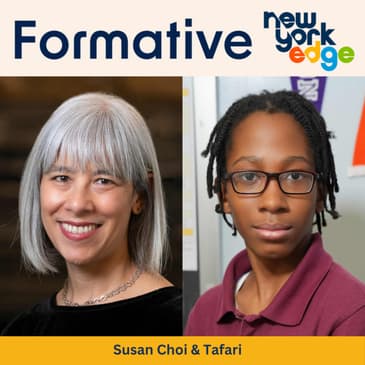

Susan Choi joins us on today’s show! Susan is a 5-time published author. Her latest novel, Trust Exercise, won the National Book Award in 2019. Joining Susan is 8th-grader and co-host, Tafari, who learns the importance of pursuing what feels the most fun for us, even when that doesn’t look like it can directly lead to a clear career path because true success comes from enjoying what we do for work. In this episode of Formative, Susan shares her joy for reading and what her creative process looks like when writing her novels.
Downloadable transcript here
INTRODUCTION
Welcome to Formative, the show where today’s leaders are interviewed by the leaders of tomorrow.
Formative is brought to you by the generous support of Macy's Inc. whose purpose is to create a brighter future with bold representation from underrepresented youth so we can realize the full potential of every one of us.
GUEST INTRODUCTION
Our guest today is Susan Choi. Susan is the author of five award-winning novels. The Foreign Student, Susan’s debut novel, won the Asian-American Literary Award for fiction. Her second novel, American Woman, was a finalist for the Pulitzer Prize in Literature. Susan’s latest novel, Trust Exercise, won the National Book Award in 2019. She’s also the author of Camp Tiger, a picture book for children. We are so thrilled to be speaking to Susan today.
INTERVIEW
Rachael: Hello and welcome. I'm Rachael Gazdick, CEO of New York Edge, and my co-host today is Tafari from M.S. 382K. Welcome. So, Tafari, can you tell us how old you are?
Tafari: 11. I’m 11.
Rachael: And what kind of things do you like to do in your spare time?
Tafari: I like to draw comic books and sometimes play games.
Rachael: Amazing! And are you excited for today's conversation with Susan Choi?
Tafari: Yeah.
Rachael: Alright let’s not wait any longer and welcome Susan Choi to the conversation. Susan, thanks for joining us today.
Susan: Thanks for having me.
Rachael: So, Tafari, I will go ahead and hand off the mic to you. What’s your first question for Susan?
Tafari: What kind of novels have you written?
Susan: So, I have written five novels for grown ups. One of them is called The Foreign Student. That was my first one, and it's about a young Korean man who comes to the United States in the 1950s after the Korean War to go to college. Um, one of them is called, I'm just kind of randomly choosing a couple from the five. One of them is called A Person of Interest and it's about a math professor who's accused of being a crazed bomber, but he actually isn't. And my most recent book is called Trust Exercise and it's about a lot of different things, but in part it's about high school students at a drama school.
Tafari: Do you have any plans in making any newer books?
Susan: I'm working on a new book right now that I'm hoping, I actually am hoping that I'm done with it, to be honest. But I don't really, I don't really get to feel done until my editor tells me that I'm done. And I gave it to my editor pretty recently and I'm waiting for her to read it and really keeping my fingers crossed that she'll say, you're done, but she might not. And if she says I'm not done, I'll have to do some more work.
Rachael: Susan, you mentioned having an editor.
Susan: Yeah
Rachael: And hoping your editor thinks that your book is done. Is the editor your boss?
Tafari: Oh yeah.
Rachael: And could you explain a little bit about how that works?
Tafari: That’s a good question.
Susan: Well, it's not really my boss. I mean, editors work for publishing companies. So, publishing companies, they publish books and that's their business. So, the editor wants your book, they want it to be, you know, as good as they think you can make it so that they have as much of a chance as possible of selling copies. And so, it's kind of delicate because my editor isn't really my boss, like, my editor, it's more like we're collaborators, but my editor, you know, is really an employee of the publisher. So my editor is trying to get the best book that she can get out of me without driving me crazy and making me really sad.
So, we sort of have to collaborate where my editor might say to me, like, you know what? I think you've worked really hard, but I think you could do a little more that would make this a little better. My editor is just trying to help me do the best job I can.
Tafari: Uh, how many, like, award winning books have you won? So like, how do you feel when you win these writing awards?
Susan: Um, not that many. I mean, it's really nice to win awards, but it's very unusual. There's way more great books than there are awards. So, I won an award for my last book and that was really nice. I'm looking at it, I actually can see it from where I'm sitting. It's a really heavy award and I mainly worry about it falling off the shelf and breaking my foot.
I think that the best way to explain how I feel is to tell you the story of what happened when I won this award, which is that I was at this big fancy party where they announced the winner and everybody was, like, sitting at tables and then there was a stage and the person who gave out the award was on the stage and they, like, read off the names of all the people who were nominated for the award and then they said, you know, and the winner is, kind of like if you've ever watched the Academy Awards, and then they said my name and I was so shocked and happy and surprised that apparently I got up from the table and just went plowing toward the stage and a friend of mine came running toward me to try to hug me and I, like, blew right past her and I almost knocked her over, apparently, because I didn't even see her.
Um, I think that sums it up. I was so shocked that I, like, didn't even see my friend try to give me a hug and might have almost run over her.
Tafari: Okay. Um, another question. What inspired you to start writing?
Susan: That's a great question. I guess, I mean, I don't know what inspired me. I just liked doing it and I didn't really, I didn't really think, oh, I want to start writing. It's just kind of a thing I did. Like, I don't know if there's a thing that you just do for fun. But, I wrote little stories for fun when I was a kid, like, a little kid, like probably right around the time I learned how to read and write, which, you know, when is that? Like, first grade, something like that? I started writing little stories of my own just for my enjoyment and, you know, they were not very long. I wrote a story about going camping with my dad and there was a spider in the tent and it was very creepy This is a pretty short story with, like, a pretty happy ending which is that the spider leaves the tent and so I just liked, I Liked doing that kind of thing from a really early age and the thing that took me a much longer time was figuring out that I could try to do it for a career. That didn't occur to me for a long time.
Tafari: So you said you write adult books, right?
Susan: Yeah.
Tafari: So, what makes the difference between the adult books and the kid books?
Susan: I think the main thing is that the books that I write for adults, I think that they're just not books that would be interesting to kids because they're more like about adult experiences and themes and ideas. But then, you know, more basic differences are they're long, like, my books are several hundred pages long, they don't have pictures. They're the kinds of books that I would not have read when I was a kid. But the truth is I've always wished that I could write chapter books for kids because I really, really like those books, and I still really like some of those books that I read as a kid. But I don't actually have a good imagination, so my books are about things that happen to adults that you know are the sorts of things that happen to adults I know and a really, like, imaginative book, I don't tend to have that kind of idea, do you know what I mean? And so, I can't really write good books for kids.
I wrote a picture book for kids, but the truth is, and this is not a secret, my son had the idea. It was his idea. So I actually had to steal that idea from my own kid. He gave me permission. But I just don't have the right imagination to write kid books.
Tafari: I wrote a few chapter books in my free time. I wrote a book about these guys. They were climbing a mountain. They're all, there’s six of them in total. And on the mountain, as they're climbing, this guy's, like his hook for climbing the mountain, breaks and he gets stuck. He has to use one hand to hold him up, but he's attached to another guy. So the other guy might be able to catch him, but there's one problem. Since his hook is kind of stuck, he could fall and it’ll also cut the rope at the same time. Since he's a mountain climber, he can hold, he has the strength to hold it up, but he slips, cutting the rope, causing him to fall.
Susan: And they're all connected, right?
Tafari: Yeah, they're connected.
Susan: That's amazing. Are you telling me that you wrote this book?
Tafari: Yeah, I wrote this.
Susan: How long is it?
Tafari: Not long. It was like 17 pages.
Susan: Wow!
Tafari: Because each page, I just put a bunch of writing.
Tafari: Um, another question I have for you is, what kind of advice would you give to a younger writer?
Susan: That's a great question. I mean, the advice that I would give is just write a lot and do it for fun. Don't worry too much about making it a job or worry too much about, is someone going to like it. You know, eventually maybe, maybe it could be your job and maybe people will like it, but writing is actually a really great thing to do if you just have fun doing it. And if you don't have fun doing it, I wouldn't sweat it. I would do something else. But I think, mostly, for younger writers just write stuff. Just write stuff for yourself to have a good time.
Tafari: What is your favorite genre and why?
Susan: For reading books?
Tafari: Yeah.
Susan: I don’t know if I have one favorite genre of books. I like lots of different kinds of books, but I guess I probably enjoy the most reading novels. And that's probably why I write them, because I really like to read them, although I like reading all different kinds. But I like all sorts of books. I like reading poetry sometimes, I like reading graphic novels a lot. I like reading nonfiction books sometimes when I'm interested in the topic. So, I don't really have one genre I like more than others.
Tafari: Another question I have for you is, like, what was one of your very first books?
Susan: Ooh, that's a fun question. Um, I'm trying to remember, like, I don't really remember picture books that I liked. I mean, I know that I read picture books and liked them, but the books that I remember are more like chapter books that I started reading like Charlotte's Web. I don't know if you know that book, or Stuart Little, which is a book about a boy who's actually a mouse. Everybody acts like it's not strange. His family is human but he is a mouse. I was really, I loved this book because he was small and everything had to be made small for him. And I really liked stories about people or, I guess, beings who were small. So, I also liked these books called The Borrowers, which were about these tiny people who had to steal stuff from humans to live and they would like, you know, sit on a spool of thread and stuff like that because they were very, very small.
Tafari: So, like, basically, what is your favorite book?
Susan: My favorite book, like, my one favorite book?
Tafari: Multiple, doesn't matter.
Susan: Okay, good, multiple is, that's helpful because I like a lot of different books. I think one of my favorite books for grownups is called The Great Gatsby, and I reread it quite often. I just really enjoy the way it's written. Another one of my favorite books is a collection of short stories by a writer I really admire named Alice Munro, who's a Canadian short story writer for grown ups. Another one of my favorite books actually is Stuart Little, the book that I told you about, about the boy who's actually a mouse. I still really love that book. Have you read it?
Tafari: Yeah, I read the first one. It wasn't bad. Have you ever read Poppy?
Susan: Poppy?
Tafari: The book Poppy? Or Ragweed?
Susan: No, who wrote those?
Tafari: It's a really interesting book.
Susan: Those sound good.
Tafari: It's actually really interesting. It's about a mouse, right? Mice. And basically, they live out in the open and there's an owl called Mr. OCax, who comes and eats Ragweed, and basically eliminates Ragweed.
Susan: Wait, Ratweed is one of the mice?
Tafari: Yeah.
Susan: Oh, that's kind of sad. That sounds very stressful.
Tafari: Ah. Have you ever read the book, Home of the Brave?
Susan: Mm mm, I don't think so.
Tafari: That one's really, really interesting. Cause that one's about an African boy who was in a war. He thought his mom was dead because in the war, he ripped off a piece of his mom's dress and it had, like, blood on it. And he would get, like, sad flashbacks. And he had to live with his aunt and he had to move to Minnesota. And he didn't know everything at first, and he slowly but surely developed English and learns about, uh, stuff in Minnesota/America.
Susan: Now, when you read a book like that, does it, how does that make you feel? Like, do you find that kind of book, because that sounds very sad and disturbing. Like, I don't know, that might give me really bad dreams.
Tafari: Yeah, it was actually very interesting.
Susan: Yeah, so you feel like you don't mind reading a book that kind of has tough events like that in it?
Tafari: Yeah, it depends. Because in the end, it has actually a happy ending where he finds his mother. So, if it has a happy ending, yes. If it has a cliffhanger ending, eh. But if it has, like, a bad ending then I won't really like the book because having all the characters have to experience those bad feelings and then have a bad ending in the end, it's just kind of sad overall.
Susan: Yeah, I know what you mean. It's true. Like, if a book puts you through a lot of anxiety and sadness, but then it has a happy ending, it feels worth it.
Tafari: Yeah.
Susan: You're a great reader, you know about great books.
Tafari: Yeah.
Susan: That’s awesome, I’m so glad. I hope you keep reading your whole life. I'm interested in asking you, but I would, I would be surprised if you really had an answer because I hated it when grown ups asked me this when I was your age, do you know what you want to be when you grow up? And I didn't when I was your age, but do you have any, do you have any thoughts?
Tafari: At my age right now, I wanna be a professional basketball player cause I have, like, I play really nice. And I'm not saying I won't make it or I will make it, but I have really good skills and I think I could make it in the future.
Susan: That's excellent. I love that. And also, do you have fun playing basketball?
Tafari: Yeah, I have a lot of fun playing basketball.
Susan: See, isn't that great? Wouldn't it be, I mean, I hope that that works out because, and whatever you do, just keep playing basketball because it's really great to do something that you enjoy.
Tafari: Oh, I have one more question.
Susan: Okay.
Tafari: Do you ever plan on retiring in the future?
Susan: Oh wow, I would love to retire to be honest. I mean, I guess I'm not really planning on it. Actually, I lied. I don't love that idea so much, Tafari. I just, I have a publisher who prints my books and sends them to bookstores and stuff and they're always kind of asking me like, where's your book? So I do dream of getting to where nobody's asking me that. I'd like to get to where I don't worry so much about writing my next book that I can just relax and sort of be like, you guys just wait, I'll give it to you when I'm ready. So I'm looking forward to that. But, you know, I think retiring is a dream for people with, like, a different kind of work. But the thing about writing is that I actually do find it fun and I feel like I could keep doing it, like, my whole life.
Rachael: Well, Susan, this was just great. On the show, we always end these conversations with the same question and that is this, if you could talk to yourself when you were 13 years old, what would you tell yourself?
Susan: You know, I would say, it's not actually true that you're really bad at all the sports. You should give it a try. I’m serious, I was deeply afraid of gym and always terrified of being, like, chosen last at kickball and was really, really convinced that I was no good at any kind of sports or athletics. And It's too bad because then I, like, went to a high school where there was no gym on purpose so that I never had to do gym again and then, like, I just never played any sports or was athletic and now I kind of like, you know, running around and stuff and I wish that I hadn't decided when I was 11 that I was, like a clumsy, unathletic person because I think I would have enjoyed running around and being more active.
Tafari: Out of all the sports you play, like, which one is your favorite?
Susan: See, I don't play any sports.
Tafari: Like, when you used to.
Susan: Actually, I played soccer. I played soccer when I was 12 and 13 but I wasn't that good at it, and so I didn't keep doing it. But I wish that I had kept doing it even though I wasn't that good at it because I just enjoyed it. But I decided I wasn't sporty. Does that make sense? I sort of decided I was not a sporty person.
Tafari: Well, that’s okay.
Susan: I should have kept doing it. You know? So that's what I would say to me at that age. I would say keep being, keep doing that stuff even if you're not, like, the best athlete.
Rachael: Oh, thank you, Susan, so much for joining us today. And thank you, Tafari, for being such an excellent co-host.
Susan: Yeah, this was super fun. Thank you. And Tafari, thanks for your questions. And, you know, it was really fun talking to you.
Tafari: No problem.
CREDITS
Thanks for listening to Formative, a production of New York Edge. I’m your host, Rachael Gazdick. Brought to you by the generous support of Macy’s, Inc. Our production partner for this series is CitizenRacecar. This episode was produced by Hager Eldaas, post-production by Alex Brouwer, production management by Gabriela Montequin, original music by Garrett Tiedemann. Thanks to the whole team at New York Edge for making this series possible. Never miss an episode by subscribing to the series at newyorkedge.org/formative or wherever you get your podcasts.