
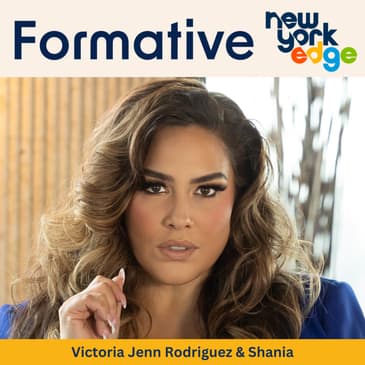

Victoria Jenn Rodriguez, mindset coach, business consultant, and host of the Banking on Cultura podcast, joins middle schooler Shania for a conversation about blazing your own trail. Victoria shares what it was like to be the first in her family to graduate college, the challenges of starting her own business, and how her identity has shaped her journey. This episode is all about bold beginnings, self-belief, and creating your own path forward.
Rachael: Welcome back to Formative. Today we're talking to Victoria Jenn Rodriguez. Victoria is a master mindset and business consultant and the executive producer and host of the Banking On Cultura podcast. She shares what it meant to be the first in her family to graduate college, to start a business, and how those experiences shaped her path.
Rachael: Hello and welcome. I'm Rachael Gazdick, CEO of New York Edge, and my co-host today is Shania from M.S. 588K. Shania, tell our audience a little bit about yourself.
Shania: Hi, my name is Shania Lewis. I'm 13 years old. I'm from Middle School of Arts and Philosophy. My favorite subject is math. And some activities I like to do is dancing and acting.
Rachael: Very cool. You have a very full schedule there. Now, can you tell us a little bit about our guest?
Shania: Okay, today we have Victoria Jenn Rodriguez. She is a businesswoman that helps other women with their business and financially.
Rachael: Very exciting. Victoria, welcome to our show. We're so happy to have you.
Victoria: Thanks for having me, super excited to be here.
Rachael: Well, let's get started. Shania, what's your first question for Victoria?
Shania: Okay, what's a normal day for you as a businesswoman?
Victoria: Ooh, a normal day for me is that it's never normal. There's always something new happening. You know, one of the benefits of running your own business is that you get to call the shots, right? You get to make the rules. So you get to wake up when you want, you get to go to sleep when you want, you get to schedule meetings for when you want. So, usually my day looks like I wake up. I check my email to see what's happening in the world, make sure nothing is falling apart that I need to call the alarm on. And then kind of go through my morning routine, doing the self-care, writing in my journal, maybe fitting in a yoga session and some meditation time before I kick off the day. Because every day looks different, some might look like in-person meetings, another day might look like virtual meetings.
Then I always make sure that I schedule some time to think every day on my calendar and I am always making sure that whatever I do, regardless if I have meetings or not, regardless if it's a jam packed day that I'm putting in time in there to make sure that I'm having some fun and make sure that I'm smiling as much as possible.
Shania: Okay. It sounds like you're having a very predictive day. Okay, my next question is, what was it like growing up in New York as a Latina when you were younger?
Victoria: It was amazing. I grew up as a daddy's girl. He raised me as a single parent. And with any loving dad, you know, he spoiled me. He made sure that I didn't have a need for anything. And actually when I was young, I grew up in a very, I would say, low middle class neighborhood, but I wouldn't know, right? Because the way that he raised me, I felt like we were rich and anything I wanted, I got it. I never felt like we were limited in anything that I did. So it was a really great upbringing for me. And one of the things he always made sure to instill in me is to own my latinidad, right, and own my culture, own where I come from, and not be ashamed of the amount of money we made or the degrees that I had, or our neighborhood or my family. He really instilled a lot of confidence in me and showed me about strong work ethic. He used to wake me up at like 4:00 AM in the morning, brush my hair, and dad's brushing girls' hair is never a good time, and would dress me up and we would go open one of his restaurants that he would have in New York City. So I got to see for myself what working hard really looks like, which is why I believe I have the work ethic that I do and also the confidence that I have because of the way that I was raised.
Shania: That sounds nice. Um, was there ever a time in your career where you wanted to quit?
Victoria: Every other day, baby girl, every other day, okay? It is hard. It is hard bringing your dreams to life. It is hard, you know, living life on your terms. It is hard to take risks. It's hard to be the first in your family to start a business. It's hard to be the first in your family to go to college because there's no blueprint, right? There's no, like, roadmap. It's you winging it and figuring it out as you go.
Shania: Mm-hmm.
Victoria: But I can say that whenever you bet on yourself, and I don't know if you've learned this yet, Shania, but whenever you bet on yourself and you believe in yourself, you always win. Even if you may not reach a goal or you may not, you know, achieve everything that you set out to achieve, just the action of believing in yourself and betting on yourself is going to prepare you for whatever you are destined to do in life.
So, it's scary and it's kind of like you making the decision and choice to do the hard stuff so that you can take advantage of 98% of what the majority of people can't do because they're too scared, right? And they're not willing to take the risk.
Shania: Hmm. So my next question is, how did you feel being the first businesswoman, as well as first person in your family to graduate with a four year degree?
Victoria: It felt really good. It felt like my family's here, like we're on the map, like I'm changing the trajectory of my family tree, right? I am progressing my family. And so it felt really good. It also felt a little lonely, right? Because as I said, there was no one that I could really go to like, like I couldn't talk to my dad about, like, colleges, right? My dad came to this country with $50. He did not graduate high school, and he managed to make a beautiful life for himself. But he didn't know what an Ivy League was. He didn't know what a two year college was versus a four year college, right? He didn't know the degrees. So he wasn't someone that I could talk to, nor was there anyone else really in my family that I could talk to because I was the first one.
So I had to go out and seek people who knew and who I could ask those questions to. So even though it was scary and it was lonely, it also was really cool and great because now I can talk to my little cousins. Now I can talk to my nieces and my nephews about the experience so that they're more prepared than I was.
Shania: Okay. So outside of anybody from your family, was there anybody else that inspired you to do what you're doing today?
Victoria: Yes, so I am inspired by a woman. Her name is Shirley Rodriguez Remeneski. She was a woman that I met when I was in college. She had a nonprofit called 100 Hispanic Woman, and I found out about her because there was once upon a time I wanted to be a politician, and so I went to her because she was bringing students out to Albany to debate legislation at the Capitol. And so that's how I met her. And she grew a liking to me, she kind of took me under her wing and she was a huge player within the community…
Shania: Mm-hmm.
Victoria: …and within the city. She grew up in the South Bronx, and I got to see from her what it was like to be a successful Latina and what it was like to really like, you know, own who you are and call the shots. And what it was like to have a penthouse on Central Park, and what it was like to win all these awards, and what it was like to open up a charter school, which I'm on the board of a charter school that she opened years ago, and so. And so, she's a big reason why I am the woman I am today. She's unfortunately no longer with us, so God bless her soul, but she is a huge part of the life that I live now. It's so important for you to have people that believe in you and, like, see you and lift you up.
Shania: Okay, another question I have is, what's one quote that you would tell young people like me?
Victoria: One of my favorite quotes is: “You can lead a horse to water, but you can't make him drink it.” And what that means is you will probably come across a lot of people who give you great information, who give you strategies that you can implement in your life, who will give you tips and tools and resources for you to live the life of your dreams. But if you don't act on those opportunities, or if you don't execute on the information that is given to you, you'll remain stagnant. So in this era of like information overload where you're constantly consuming, consuming, consuming, consuming, right, with social media and everything, make sure that while you are consuming, that you are also executing because that is the only way that you are actually going to be able to achieve your goals and make your dreams come true.
Shania: What did you wanna be when you were in middle school?
Victoria: I wanted to be a lawyer.
Shania: Oh?
Victoria: Yeah, I wanted to be a lawyer because your girl loves to debate. She loves to have a good conversation and really disagree and have smart conversations. And so, lawyer just kind of felt like, okay, I can kind of, you know, make a business case for something. I can argue my point of view. And then I had an internship in the Queens District Attorney's office where I got to, like, really see a behind the scenes of, of what lawyers go through and what their day in the life is all about, and I quickly realized I did not wanna be a lawyer anymore.
Shania: Yeah, a lawyer. I wanted to be a lawyer, but that seems like it would take a lot, and I don't know if I'm prepared for that yet.
Victoria: Yeah, for me it was a lot of reading. That's what I saw, right? It was a lot of reading, a lot of paying attention to detail, which is great and is definitely a skillset that we should all have. But I realized in that moment, which is why it's so important to have internships and to have different types of experiences so that you can learn what you wanna do and also what you don't wanna do, and also learn about yourself. And what I learned is I'm more of a visionary kind of girl, kind of big picture, creative, you know, vibrant, a lot of color. I'm not one that thrives in the details and I think that's where lawyers really shine, is paying attention to the details.
Shania: So how is it like for you in middle school?
Victoria: So it was fun. I was always talkative and, you know, loud and had a lot of friends and was always really popular. And so, I never had a hard time fitting in but I think that's also because, you know, the schools that I went to were diverse.
Shania: Mm-hmm.
Victoria: So there were people who looked like me and I also was just a very outspoken young girl. Um, but I do remember being a chubby kid. I was a real chubby kid, so I used to get teased a lot when I was younger about my weight, which I think at the time really was sucky and didn't feel great.
Shania: Mm-hmm.
Victoria: But it was preparing me to have thick skin and to really own, right, who I was and be comfortable in my own skin.
What about you? How's school for you?
Shania: So I can relate to what you said because like I'm usually the person that lights up the room when I come in. Like, I have a good personality. I'm always loud. I always try and speak my mind. And I like being nice to people, like even if me and them aren't friends, I'll still be nice to you.
Victoria: Okay.
Shania: Yeah. I just try to live in a good environment. Like, if I realize you're toxic, I'm gonna cut you off. 'cause I don't want that into my circle.
Victoria: Hmm. Girl, you sound like a 40-year-old woman right now. That's what all my friends are saying.
Shania: Okay. Another question I have is where do you see yourself in the next 10 years?
Victoria: In the next 10 years, I see myself being a well-known, development personality. I see myself having a super, super successful podcast, so I have a podcast called Banking Cultura. Cultura means culture. And so, it's all about using your culture as a competitive advantage versus an Achilles heel and learning about entrepreneurship and how to increase income streams. So I see that podcast turning into a syndicated show. And in 10 years I also see myself as an author.
Shania: Mm-hmm.
Victoria: Finally writing the book that is in my notes on my phone. I literally have all the chapters written out. I just gotta put it out there. And I also see myself just continuing to be a place where people come for light and joy and to build their competence.
Shania: That sounds nice.
Victoria: What about you? Where are you gonna be in 10 years?
Shania: In 10 years I'll be 23, so I hope, I really do hope that I go on the track where I'm in college, I wanna do my four years. In 10 years I should be in college trying to figure out, like, what I wanna do. I hope that I either become a maternity nurse or, either that or, I don't know what else I wanna be. That's just like my main focus right now, what I'm trying to be.
Victoria: Okay. Can I give you some advice?
Shania: Yeah.
Victoria: So whenever you are talking about your future, instead of saying, ‘I hope,’ say ‘I will’ or ‘I am,’ right. And be specific about it, right? Like, I will be attending a four year college and I'm graduating and I'm a maternity nurse, and I love the work that I do. I have amazing colleagues, right, really visualizing it. Making it your own will help it become true and also train your mind and your belief system to know that it is true, which increases the probability that will happen versus saying, I hope. Does that make sense?
Shania: Yeah.
Victoria: So that's your homework. When you go home today, you're gonna write, I will go to a four year college, I will. Even if the story changes later, right, which is the beautiful part about life is it will. It will.
Shania: Mm-hmm.
Victoria: Right? I wanted to be a lawyer back then and I'm nowhere near that now, right. So it probably will shift and change but just you being very particular and specific and intentional about the life that you wanna live increases the likelihood that is the life you will indeed live.
Shania: Okay, so manifest it into being.
Victoria: Yes.
Shania: Okay, so my next question is, what is something you would tell your younger self?
Victoria: I would tell her that you're destined for greatness, and as long as you keep going and you keep showing up, the world is yours.
Rachael: Thank you, Victoria. This was a pleasure.
Victoria: This was amazing. Thank you so much. I love talking to you.
Shania: I love talking to you too.
CREDITS
Thanks for listening to Formative, a production of New York Edge. I’m your host, Rachael Gazdick. Our production partner for this series is CitizenRacecar. This episode was produced by Hajar Eldaas, post-production by Alex Brouwer, original music by Garrett Tiedemann. Thanks to the whole team at New York Edge for making this series possible. Never miss an episode by subscribing to the series at newyorkedge.org/formative or wherever you get your podcasts.